


In the dynamic landscape of modern business, embracing cloud technology has become more than a trend; it’s a strategic imperative.
However, the journey to the cloud is not without its challenges. Organisations grapple with complexities ranging from legacy system integration to data security and change management.
To navigate this intricate terrain, an Enterprise Cloud Adoption Framework becomes the guiding compass, ensuring a structured and successful journey to the cloud.
In this blog, we will explore the nuances of cloud adoption challenges, the imperative need for an enterprise framework, and the essential components that constitute a comprehensive roadmap for seamless cloud integration.
Understanding Cloud Adoption Challenges
Legacy System Integration
The integration of legacy systems with cloud infrastructure poses a significant challenge.
Many organisations operate with entrenched systems that may not seamlessly align with cloud architecture.
Bridging this gap without disrupting ongoing operations requires careful planning and execution.
Data Security
Security concerns often top the list of challenges during cloud adoption. Entrusting critical data to a cloud environment necessitates robust security measures.
Organisations need to address issues such as data encryption, access controls, and compliance with industry regulations to ensure data integrity and confidentiality.
Change Management
The shift to cloud technology is not merely a technological transition; it’s a cultural and operational shift.
Managing this change effectively requires comprehensive change management strategies, including communication plans, training programs, and fostering a cloud-ready mindset among employees.
Vendor Selection
Choosing the right cloud service provider is a critical decision. The market is flooded with options, each offering unique features and pricing structures.
Navigating through this sea of choices requires a thorough understanding of organisational needs, compatibility, and long-term goals.
The Need for an Enterprise Cloud Adoption Framework
Structured Approach to Cloud Adoption
In the face of these challenges, organisations need more than ad-hoc solutions; they need a structured approach.
An Enterprise Cloud Adoption Framework provides the necessary structure to streamline the adoption process.
It offers a clear roadmap, reduces risks, increases efficiency, and facilitates better decision-making throughout the cloud adoption journey.
Increased Efficiency
A structured framework enhances efficiency by providing a standardised methodology.
This methodology ensures that processes are well-defined, resources are optimised, and timelines are adhered to.
Efficiency becomes a hallmark of organisations that adopt a systematic approach to cloud integration.
Reduced Risks
Cloud adoption is not without risks, but a well-defined framework helps identify, assess, and mitigate these risks proactively.
By establishing a risk management plan, organisations can navigate potential pitfalls, ensuring a smoother transition to the cloud.
Better Decision-Making
Informed decision-making is the bedrock of successful cloud adoption.
A framework enables organisations to make strategic decisions based on a comprehensive understanding of their current state, future goals, and the intricate nuances of cloud technology.
Components of an Enterprise Cloud Adoption Framework
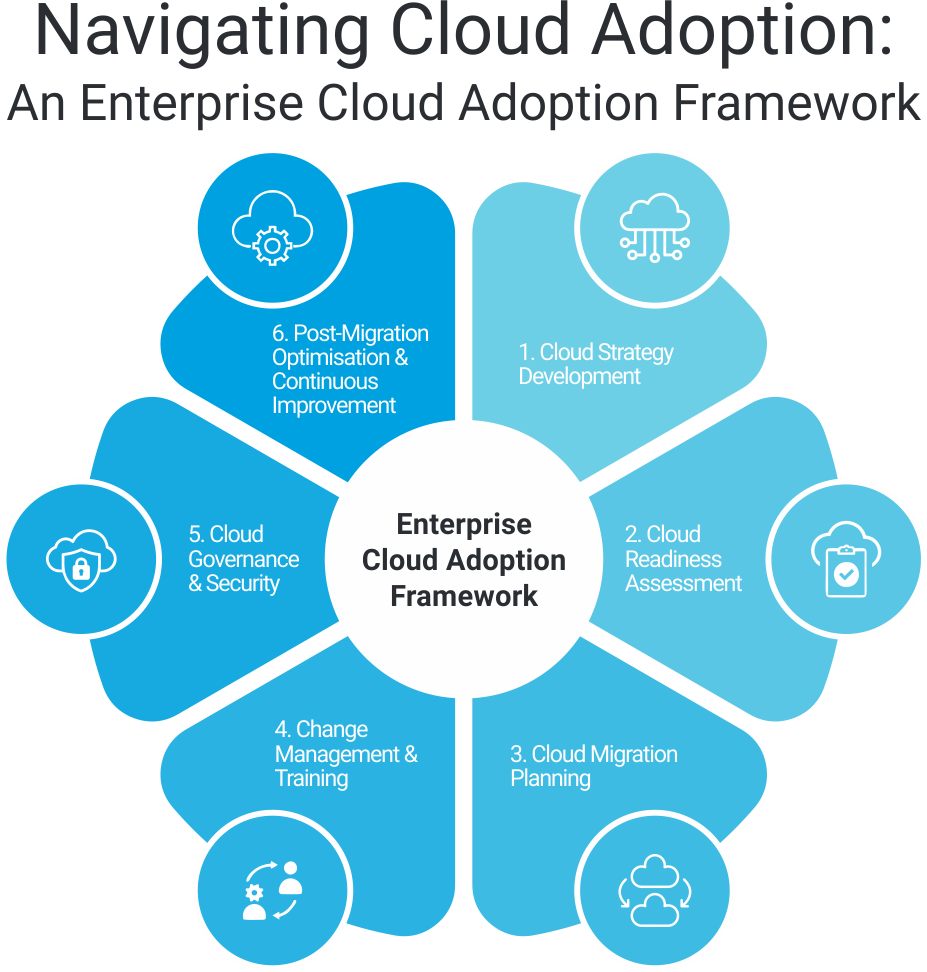
Cloud Strategy Development
Aligning Business Objectives with Cloud Capabilities
The first step in the framework involves developing a cloud adoption strategy. This requires aligning business objectives with the capabilities offered by the cloud.
Organisations need to identify how cloud technology can enhance their operations, improve scalability, and contribute to overall strategic goals.
Evaluating Different Cloud Models
Cloud computing offers a variety of deployment models – public, private, hybrid, and multi-cloud.
Organisations need to evaluate these models based on factors such as security, compliance, and cost-effectiveness to determine the most suitable approach for their unique needs.
Defining a Phased Approach
The development of a phased approach is crucial for the success of cloud adoption.
Breaking down the adoption process into manageable phases allows organisations to prioritise workloads, allocate resources effectively, and measure progress systematically.
Cloud Readiness Assessment
Assessing Current IT Infrastructure, Applications & Security Readiness
A comprehensive cloud readiness assessment is the cornerstone of successful adoption.
Organisations must evaluate their existing IT infrastructure, applications, and security protocols to determine their readiness for migration to the cloud.
This involves assessing factors such as system dependencies, data architecture, and regulatory compliance.
Cloud Migration Planning
Workload Prioritisation
Not all workloads are created equal. Effective cloud migration planning involves prioritising workloads based on factors such as business criticality, resource dependencies, and potential impact on operations.
Prioritisation ensures a phased and controlled migration process.
Data Migration Strategies
Data is the lifeblood of any organisation, and migrating it to the cloud requires meticulous planning.
Organisations must develop data migration strategies that encompass data cleansing, transformation, and validation to ensure the integrity of data during and after migration.
Testing & Validation
Thorough testing is imperative to identify and rectify potential issues before they impact operations.
Testing and validation should cover aspects such as application functionality, data integrity, and performance in the cloud environment.
Potential Risks & Mitigations
Cloud migration is not without risks, and organisations must be prepared to address potential challenges.
Identifying risks and developing mitigation strategies ensure a proactive approach to overcoming hurdles during the migration process.
Change Management & Training
Driving Organisational Change
The success of cloud adoption hinges on effective change management.
Organisations need strategies to communicate the benefits of cloud technology, manage resistance to change, and foster a culture of adaptability and innovation.
Managing Employee Resistance
Resistance to change is a natural human response. Managing employee resistance involves addressing concerns, providing clear communication, and involving employees in the decision-making process.
An engaged workforce is more likely to embrace and contribute to the success of cloud adoption.
Comprehensive Training Programs
Cloud technology introduces new tools, processes, and workflows. Comprehensive training programs are essential to equip employees with the skills and knowledge required to operate effectively in the cloud environment.
Training programs should be tailored to different user roles and continuously updated to reflect evolving technologies.
Cloud Governance & Security
Establishing Cloud Policies
Cloud governance is vital for maintaining control and ensuring compliance.
Establishing clear policies for cloud usage, access controls, data management, and compliance ensures that cloud resources are utilised responsibly and in line with organisational objectives.
Managing Access Controls
Securing access to cloud resources is a critical aspect of cloud governance.
Organisations must implement robust access controls, including identity and access management (IAM) policies, to prevent unauthorised access and protect sensitive data.
Monitoring & Compliance
Continuous monitoring is essential to identify and address security threats promptly.
Organisations need to implement monitoring tools and establish compliance protocols to ensure adherence to industry regulations and internal policies.
Data Protection
Data protection is a non-negotiable aspect of cloud governance.
This involves implementing encryption protocols, regular data backups, and disaster recovery plans to safeguard against data loss or unauthorised access.
Post-Migration Optimisation & Continuous Improvement
The Need for Continuous Optimisation
Post-migration optimisation is not a one-time effort; it’s a continuous process. Organisations must adopt a mindset of ongoing improvement to maximise the benefits of their cloud environment.
Continuous Optimisation Efforts
Continuous optimisation efforts involve regularly evaluating cloud performance, identifying opportunities for improvement, and implementing enhancements.
This may include adjusting configurations, adopting new cloud services, and optimising resource allocation.
Adopting New Cloud Services
Cloud technology evolves rapidly, and new services are continually introduced.
Organisations should stay informed about these advancements and evaluate the potential benefits of adopting new cloud services to enhance their operations.
Leveraging Data Analytics for Insights
Data analytics plays a crucial role in post-migration optimisation.
Organisations can leverage analytics tools to gain insights into their cloud environment’s performance, user behavior, and resource utilisation, enabling data-driven decisions for continuous improvement.
Best Practices for Successful Cloud Adoption
Executive Sponsorship
Executive sponsorship is a key success factor for cloud adoption.
Securing support from top leadership ensures that cloud initiatives align with overall organisational goals and receive the necessary resources.
Cross-Functional Collaboration
Cloud adoption involves multiple stakeholders from IT, operations, finance, and other departments.
Cross-functional collaboration is essential to ensure that diverse perspectives are considered, and decisions reflect the broader organisational context.
Selecting the Right Cloud Service Providers
Choosing the right cloud service providers is a critical decision.
Organisations should evaluate providers based on factors such as reliability, scalability, security measures, and compatibility with their specific requirements.
Monitoring Cloud Costs
Cloud costs can escalate if not monitored carefully.
Implementing robust cost monitoring mechanisms, utilising cost management tools, and regularly reviewing expenditure ensure that organisations optimise their cloud investments.
Conclusion
In the fast-paced world of modern business, cloud adoption is not just an option; it’s a strategic imperative.
To navigate the complexities of this transformative journey, organisations need more than technological expertise – they need a roadmap. An Enterprise Cloud Adoption Framework serves as that roadmap, offering a structured approach to overcome challenges, mitigate risks, and unlock the full potential of cloud technology.
From developing a cloud strategy and conducting readiness assessments to planning migrations, managing change, and optimising post-migration, the framework provides a comprehensive guide for organisations seeking a successful transition to the cloud.
As organisations embark on their cloud adoption journey with Westbrook, the Enterprise Cloud Adoption Framework becomes the compass that ensures they navigate the clouds with confidence, efficiency, and a clear vision for future success.
Ready to elevate your organisation to new heights with seamless cloud adoption? Westbrook is your trusted partner, offering a strategic Enterprise Cloud Adoption Framework that transforms challenges into opportunities. Navigate the complexities of cloud integration with confidence, reduce risks, and unlock the full potential of cloud technology. From strategic planning to comprehensive migration and continuous optimisation, Westbrook’s expertise ensures a smooth journey to the cloud. Don’t just dream of innovation; make it a reality with Westbrook. Contact us today and embark on a transformative cloud adoption journey that propels your organisation into the future. Your success in the cloud begins with Westbrook: www.westbrook.co.uk.